
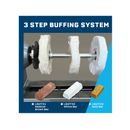
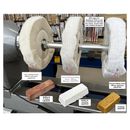
Carbatec 3 Step Buffing System
Description
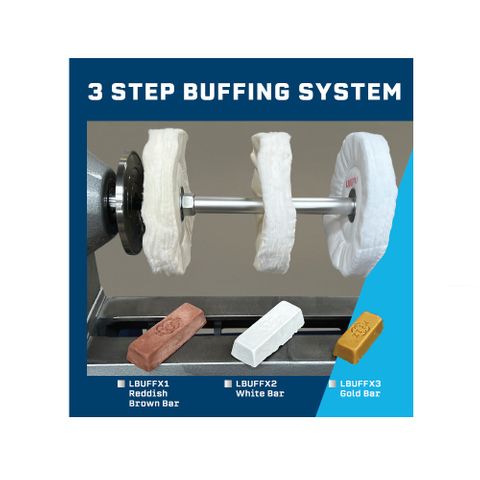
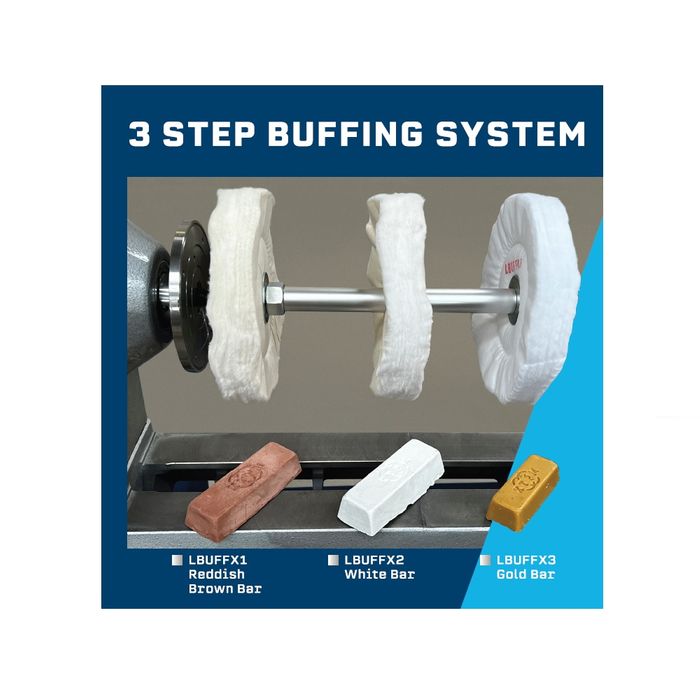
The Carbatec three-step woodturning buffing system utilizes 2 abrasive compounds followed by a wax compound to give a high gloss finish to your piece.
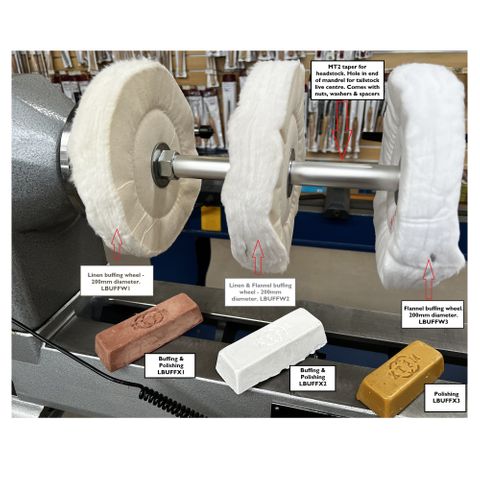
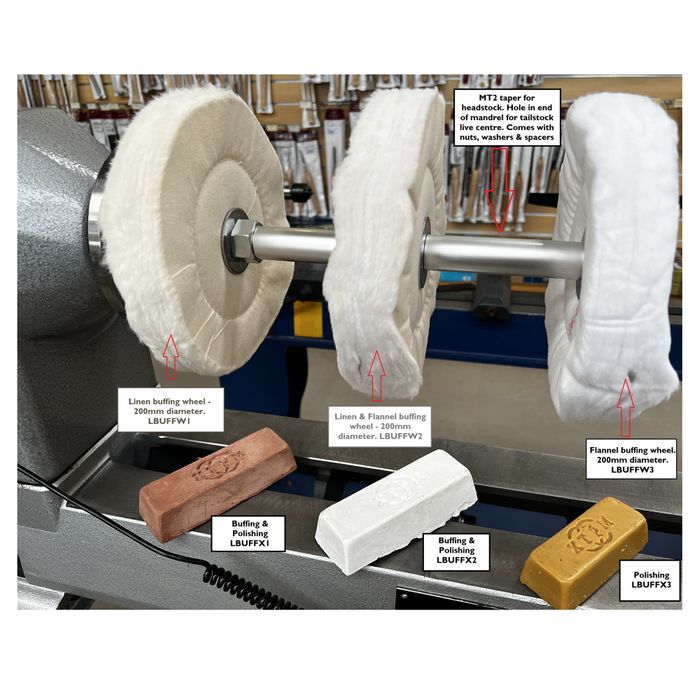
Each compound is apply sparingly to a dedicated fabric wheel which is made of either linen, 50:50 linen/flannel or flannel.
The wheels are mounted on a shaft with a #2 Morse Taper at one end to place in the headstock and a hole at the other end of the mandrel into which a live centre tip is placed for safety.
Please read the instructions carefully.
The buffing wheels need to be prepared before first use. During this process, and during use, fibres come loose and it is advisable to wear a dust mask.
Either Sanding Sealer or Danish Oil are recommended after sanding to around 400 grit. Allow to dry before buffing.
Recommended speed is between 1300 and 1700 RPM.
Hold on to the item firmly to avoid it being removed from your grip!
The Three Buffing Steps
Step 1: Red compound. Historically this is Tripoli powder which is an abrasive. The red LBUFFX1 is an abrasive which buffs the wood - it removes fine sanding marks as it smooths the wood surface. It is used on the Linen Wheel.
Apply the coarse reddish-brown compound lightly to the first stiff linen wheel. Run the lathe around 1,200 to 1,700 RPM.
Step 2: White Compound. Called "White Diamond" (although no diamonds can be seen in the formulation!) It is used on the Linen/Cotton Flannel Blend Wheel.
Apply a tiny amount of the white compound to the softer second wheel. The white LBUFFX2 cleans off leftover residue from the red compound while it polishes the surface to a fine, glass-like smoothness.
Step 3: Gold Wax Compound is used on the softer 100% Cotton Flannel Wheel.
Apply a small amount of the hard carnauba/beeswax bar to the final soft cotton wheel. LBUFFX3 buffs the piece to a deep, durable, and protective high-lustre shine.
Safety and Technique Tips
Rotation Direction: Always present the wood so the top of the buffing wheel spins away from the edge or lip of your turning; catching an edge can violently rip the piece from your hands.
Protection: Wear a safety face shield and a dust mask/respirator, as buffing throws micro-particles of wax, silica, and compound dust into the air.
Preparation: For best results, sand your turning thoroughly (up to 400–800 grit) and pre-treat the wood with a hardening oil like Danish oil before buffing.
-
AucklandAvailable
-
ChristchurchSorry, not in stock. Please contact us to backorder
You may also be interested in...
-
RSB-W493
-
AucklandLimited Stock
-
ChristchurchLimited Stock
-
-
LW50
-
AucklandSorry, not in stock. Please contact us to backorder
-
ChristchurchSorry, not in stock. Please contact us to backorder
-
-
CT-WPB-50MM
-
AucklandAvailable
-
ChristchurchAvailable
-
-
CT-WPB
-
AucklandAvailable
-
ChristchurchAvailable
-